

心理所研究揭示發音相關腦區對老年人言語理解困難的代償作用
聽力損失是老年人最普遍的慢性健康問題之一,80歲以上老年人中約有90%存在不同程度的聽力下降。聽力損失會嚴重影響到老年人的生活質量和社會交往能力。日常生活中,我們不乏處于噪音環境,比如嘈雜的餐館。研究表明,即使是聽力正常的老年人在噪音環境下也會經歷不同程度的言語理解困難。然而目前我們還不清楚,老年人的大腦如何在聽力下降和噪音環境的雙重挑戰下知覺和理解他人的言語。
隨著年齡的增加,我們的聽覺外周(包括耳蝸和聽神經)和聽覺中樞系統(負責加工和理解聲音的腦區)出現功能衰退。但可喜的是,作為一個動態的適應過程,老年人的大腦可能通過資源重組或認知策略改變以應對感知覺加工能力的下降。因此,老年人在噪音環境下加工和識別他人的言語時就需要調用更多的認知資源和腦區以作為一種代償。
通過與加拿大多倫多大學和羅德曼研究所的國際合作,中國科學院行為科學重點實驗室的杜憶研究員運用功能性磁共振成像技術發現,位于大腦前額葉的言語運動區(與言語的發音密切相關,包括布洛卡區和腹側前運動皮層)對老年人在噪音環境下的語音分辨和識別具有重要的代償作用。該研究發現最新發表于Nature Communications (doi: 10.1038/ncomms12241)。
該研究分析了16名20-34歲的年輕人和16名65-75歲的老年人在不同背景噪音強度下進行音節分辨時的大腦活動。結果發現,老年人的言語運動區比年輕人的言語運動區激活程度更高。而且,老年人言語運動區的激活程度與其任務成績顯著正相關(Figure 1)。使用一種叫做多體素模式分類的機器學習算法,他們進一步發現,即使在沒有噪音干擾下,老年人的聽覺皮層也無法對不同的音節形成特異性的神經表征。即老年人的聽覺皮層對語音信號的編碼呈現出同質化的特點。然而,老年人言語運動區的語音神經表征(可能通過對說話人發音姿勢的預測所產生)卻能在噪音干擾下保持一定程度的特異性(Figure 2)。這項研究證實了該團隊前期在年輕人上的發現,即言語運動區比聽覺皮層在噪音干擾下對語音信號的編碼具有更高的刺激特異性(Du et al., 2014 PNAS, doi: 10.1073/pnas.1318738111)。更重要的是,這項研究提示,老年人在噪音環境下理解他人的言語時會更多地依賴與發音相關的言語運動腦區并采用一種預測性加工策略,即充分利用較少受到老年化和噪音影響的言語的發音知識和預期以代償受損的聽覺加工。
該研究具有重要的臨床和工業意義,它為幫助聽力受損的老年人設計和開展言語康復訓練方案以及助聽器等聽力輔助設備的研發提供了新的視角和啟發。比如,在知道發音相關腦區對老年人的言語理解具有重要的代償作用后,研究人員可以針對該腦區設計相應的訓練方案以提高其功能以及與其他腦區的功能連接。
該研究獲得加拿大健康研究院基金支持。
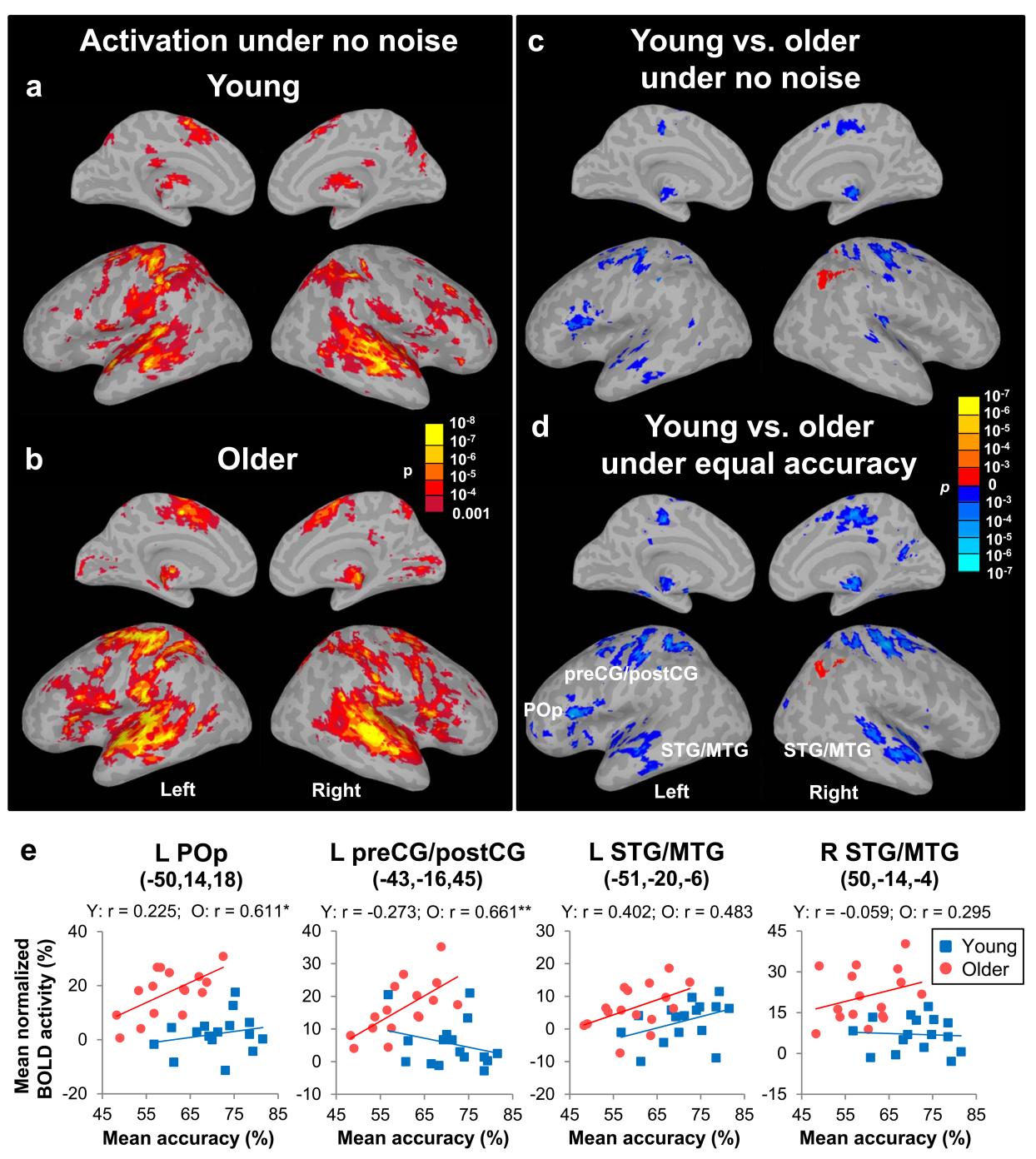
Figure 1. Age difference in BOLD activity. Activity elicited by syllable identification at the NoNoise condition in young (a) and older adults (b). Activity in young adults vs. activity in older adults at the NoNoise condition (c) and conditions when two groups equaled in accuracy (average activity at -6 and -2 dB SNRs in young vs. average activity at -2 and 8 dB SNRs in older) (d). Results are thresholded at pFWE < 0.01. (e) Correlations between the mean activity across -12 to 8 dB SNRs in four ROIs (left POp, left preCG/postCG and bilateral STG/MTG) and the mean accuracy across those SNRs in older (red circles) and young adults (blue squares). The coordinates are in Talairach space. *, p < 0.05; **, p < 0.01 by Pearson’s correlations. POp, pars opercularis; preCG/postCG, precentral and postcentral gyrus; STG/MTG, superior and middle temporal gyrus.
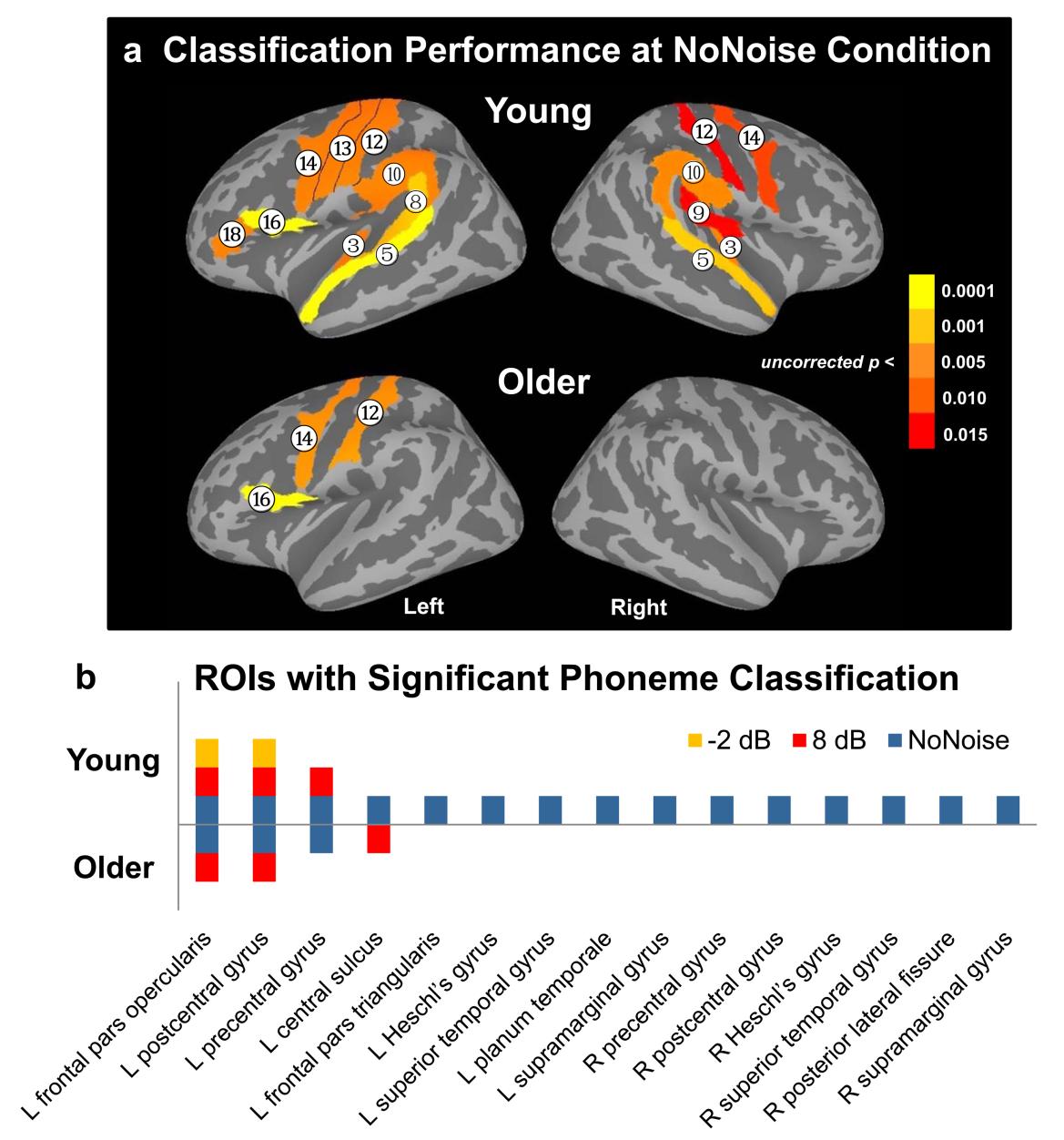
Figure 2. Phoneme classification performance. (a) Regions with significant phoneme classification (area-under-the-curver (AUC) > 0.5, one-sample t test with false discovery rate corrected q < 0.05) at the NoNoise condition for each group. (b) Overview of ROIs and SNRs when significant classification was revealed in each group. SNRs at which each ROI showed significant classification are displayed on the y-axis, with ROI labels listed across the x-axis. The top half shows data from young adults and the bottom half shows data from older adults. 3, Heschl’s gyrus; 5, superior temporal gyrus; 8, planum temporale; 9, posterior lateral fissure; 10, supramarginal gyrus; 12, postcentral gyrus; 13, central sulcus; 14, precentral gyrus; 16, pars opercularis; 18, pars triangularis.
論文信息
Du Y, Buchsbaum B, Grady C, Alain C (2016). Increased activity in frontal motor cortex compensates impaired speech perception in older adults. Nature Communications, 7, 12241.
相關論文
Du Y, Buchsbaum B, Grady C, Alain C (2014) Noise differentially impacts phoneme representations in the auditory and speech motor systems. Proceedings of the National Academy of Sciences of the United States of America, 111, 7126-7131.
附件下載: